Review: Welcome Don t Expect Much Funny Welcome
As a designer who has spent countless hours digitizing and testing embroidery patterns, I have learned that the difference between a charming handmade item and a professional-grade product often lies in the initial design selection. Recently, I evaluated Welcome Don t Expect Much Funny Welcome, a digital asset categorized under Crafts and Graphics, to determine its viability for real-world application. This is not just a theoretical review; it is an assessment of how this specific design holds up when translated from a screen to thread.
First Impressions and Visual Personality
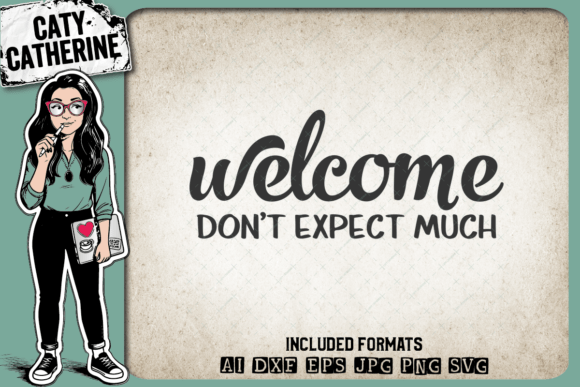
The immediate appeal of Welcome Don t Expect Much Funny Welcome is its candid, humorous tone. In a market saturated with overly sweet or generic greetings, this design offers a refreshing dose of personality. The layout suggests a bold, statement piece rather than a subtle accent. For an embroidery designer, this means the visual weight of the text must be balanced carefully. The typography appears robust, which is generally a positive sign for machine embroidery, as thin lines can easily get lost or break during stitching.
The mood created is casual and inviting, albeit with a wink. It fits naturally into modern farmhouse decor, eclectic boutique branding, or personalized gifts for friends with a dry sense of humor. When viewing the design files, including the SVG File, Transparent PNG, EPS, DXF, and JPG formats provided by designer Caty Catherine, the clarity of the vectors is crucial. Clean lines in the source file usually translate to cleaner stitch paths, reducing the likelihood of thread breaks or messy jumps.
Real-World Application: The Tote Bag Test
To truly understand the potential of Welcome Don t Expect Much Funny Welcome, I visualized it on a heavy canvas tote bag. This is a popular item for Etsy sellers and small shop owners. The design’s horizontal orientation works well across the center of a tote, creating a focal point that is readable from a distance. However, the success of this project depends heavily on the choice of thread colors and fabric texture.
On a natural cotton canvas, a high-contrast thread color would make the text pop. If using a dark fabric, such as navy or black canvas, one must ensure the design includes enough spacing to prevent the stitches from merging into a solid block of color. This is where the concept of stitch density becomes critical. A design that looks open on screen can become dense and stiff once stitched out, especially if the software auto-generates fill stitches without manual adjustment.
Versatility Across Product Lines
Beyond tote bags, this design has strong potential in custom apparel. Imagine it embroidered on the back of a sweatshirt or the chest of a structured cap. For sweatshirt embroidery, the stretch of the fabric requires a stable backing. Using a cut-away stabilizer would ensure the design remains crisp after multiple washes. For caps, the curved surface presents a challenge. The design must be scaled down appropriately to fit within the standard hoop size of a cap frame without distorting the lettering.
It is also worth considering this design for home decor items like pillow covers or kitchen towels. On a tea towel, the design would need to be simplified or reduced in scale to avoid overwhelming the delicate fabric. Here, the running stitch might be more appropriate than a heavy satin stitch or fill stitch to maintain the drape of the linen or cotton.
Technical Considerations for Embroiderers
Before loading Welcome Don t Expect Much Funny Welcome onto your machine, there are several practical steps to take. First, always test the design on scrap fabric that matches your final project material. This allows you to check the stitch density and adjust tension if necessary. If the design feels too stiff after stitching, consider reducing the density in your embroidery software or switching to a lighter weight thread.
Thread color contrast is another vital factor. Since this is a text-based design, legibility is paramount. Test the design in black and white mockups first to ensure the shapes are distinct even without color. This is particularly important for customers who may view your products in grayscale photos or from a distance.
Additionally, inspect the small details. While the provided formats include SVG and EPS, which are scalable, the actual embroidery file conversion must be handled with care. Ensure that any tiny serifs or intricate corners are large enough to be stitched cleanly. If the design includes very fine lines, they may need to be converted to satin stitches with appropriate underlay to prevent them from pulling out.
Navigating Fabric Challenges
Not all fabrics are created equal. When working with textured fabrics, the needle may skip, or the thread may sink into the pile. For such materials, a water-soluble topping can help keep the stitches on the surface. For stretchy fabrics like jersey knits, a stabilizer is non-negotiable. Without it, the design will pucker and distort, ruining the professional look of the finished product.
Dark fabrics require special attention to thread coverage. If the design has gaps, the underlying fabric color may show through, breaking the visual continuity. In such cases, increasing the stitch count slightly or using a thicker thread can help achieve full coverage. However, be mindful not to make the design too dense, as this can cause the fabric to bunch up.
Commercial Viability and Brand Consistency
For craft business owners and Etsy sellers, the commercial value of Welcome Don t Expect Much Funny Welcome lies in its uniqueness. It stands out in a crowded marketplace, offering a conversation starter that can drive engagement. However, brand consistency is key. If your shop specializes in delicate, floral designs, this bold, humorous piece might feel out of place. Conversely, if your brand voice is witty and modern, this design aligns perfectly.
When selling finished items, ensure you have the correct license for commercial use. The product description mentions it is designed by Caty Catherine, but it is essential to confirm the specific terms regarding the sale of physical goods versus digital redistribution. Never assume; always verify.
Final Verdict
Welcome Don t Expect Much Funny Welcome is a versatile and engaging design that, when handled with technical precision, can elevate a range of handmade products. From embroidered patches to holiday gifts, its appeal is broad. By paying attention to stitch density, fabric choice, and stabilizer selection, designers can ensure a high-quality finished product that meets customer expectations. Remember to check the specific file formats and licensing details before starting your next embroidery project. With careful execution, this design can become a staple in your creative arsenal.